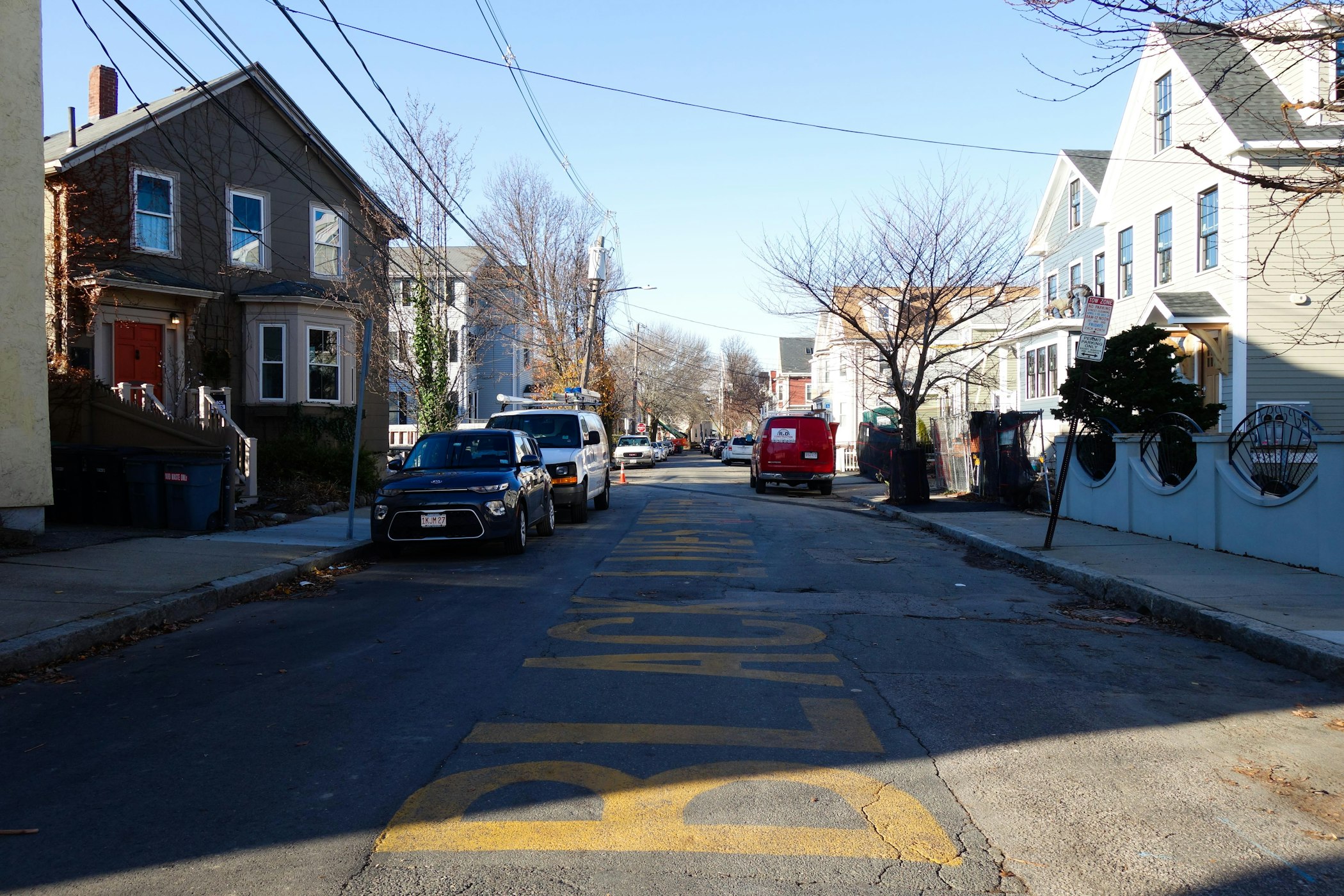
Black Lives Matter. Union Square, Sommerville, Massachusetts. 2020. ©Wiig, Alan.
A large Black Lives Matter street mural was recently painted onto Oak Street, near Union Square in Somerville, Massachusetts. Unlike more prominent Black Lives Matter murals on larger, more trafficked streets in the area, this one stands out specifically because of its installation in response to racist graffiti on an adjacent home displaying a Black Lives Matter sign in its yard. A local news blog wrote:[1]
On a neighborhood Facebook group, residents pondered what to do. Someone suggested they paint Black Lives Matter on to the street.
'I think everybody thought that was a great idea,' Sokol said. 'There's a small sign of racists over here; we can come back with a response 100 times bigger, so that's what we're doing.'
Since the start of the pandemic, my work-from-home, routine walk around the neighbourhood often takes me down Oak Street. Unlike the connectivity markers discussed above, the yellow paint of this Black Lives Matter mural conveys a call for racial justice that does not need a telecommunications network, smartphone or app developer to process and interpret the message, even if the block's residents used their Facebook group to decide on a course of action. The declaration that Black Lives Matter transcends the upgrade cycles, devices and digitisation of the platform city, even as conversations about racial justice proceed through social media and other platform technologies. As 2020 comes to a close, the calls for racial justice across the United States and around the world demand support, recognition and representation, including but not limited to street murals, or indeed social media posts.
This blog entry was drafted during the lead-up to the 2020 United States' presidential election and completed in the weeks after. The year was not over, and yet was already marked as one of the most consequential in the nation's – and indeed the world's – history. The elections were largely framed around the current president's (mis)handling of the Covid-19 pandemic and the protests for racial justice erupting out of the police murders of George Floyd, Breonna Taylor, and Ahmaud Arbery, amid the deaths of many other African Americans. Both the pandemic and the protests were wrapped up in the politics of ethno-nationalism and white supremacy enflamed by the current president and his supporters. Considerations of urban technology such as those offered in this book rarely foreground race and whiteness as part of our contemporary ambitions to understand the platform city. But just as the Black Lives Matter protests were often organised through social media platforms and smartphones distributed through the crowd, so were the counter-protests against racial justice and against a public health-driven, science-based approach to managing the pandemic, whether these protests took place in cities or not. The cellular infrastructure, data centres, and ubiquitous computing technologies that produce platform urbanism are wrapped up in wider, societal struggles for recognition, respect, equity, and justice, and we would be remiss not to recognise as much here, today.
As Ruha Benjamin's 'Race after Technology' makes clear, the platform city only contains that which platform technology corporations deem profitable based on decisions largely made by white engineers and programmers. Even though the city is more than platforms, and what is not immersive within platform apps and its infrastructure is still present, to be outside the platform implies less visibility, less awareness, less value. The platform city builds more platforms but does not or cannot account for that which remains outside the platform itself. I make this point not to call for the platform to be the place where racial justice might be actualised, but instead to recognise that the platform city is tied up in wider, societal struggles that cannot be solved by upgrading an app or installing a faster network.
Comments